
Dress Codes: The Unfair Judgement to Women's Bodies
Words by Sofhia Pagaduan
Article Banner by Helen Pajutagana
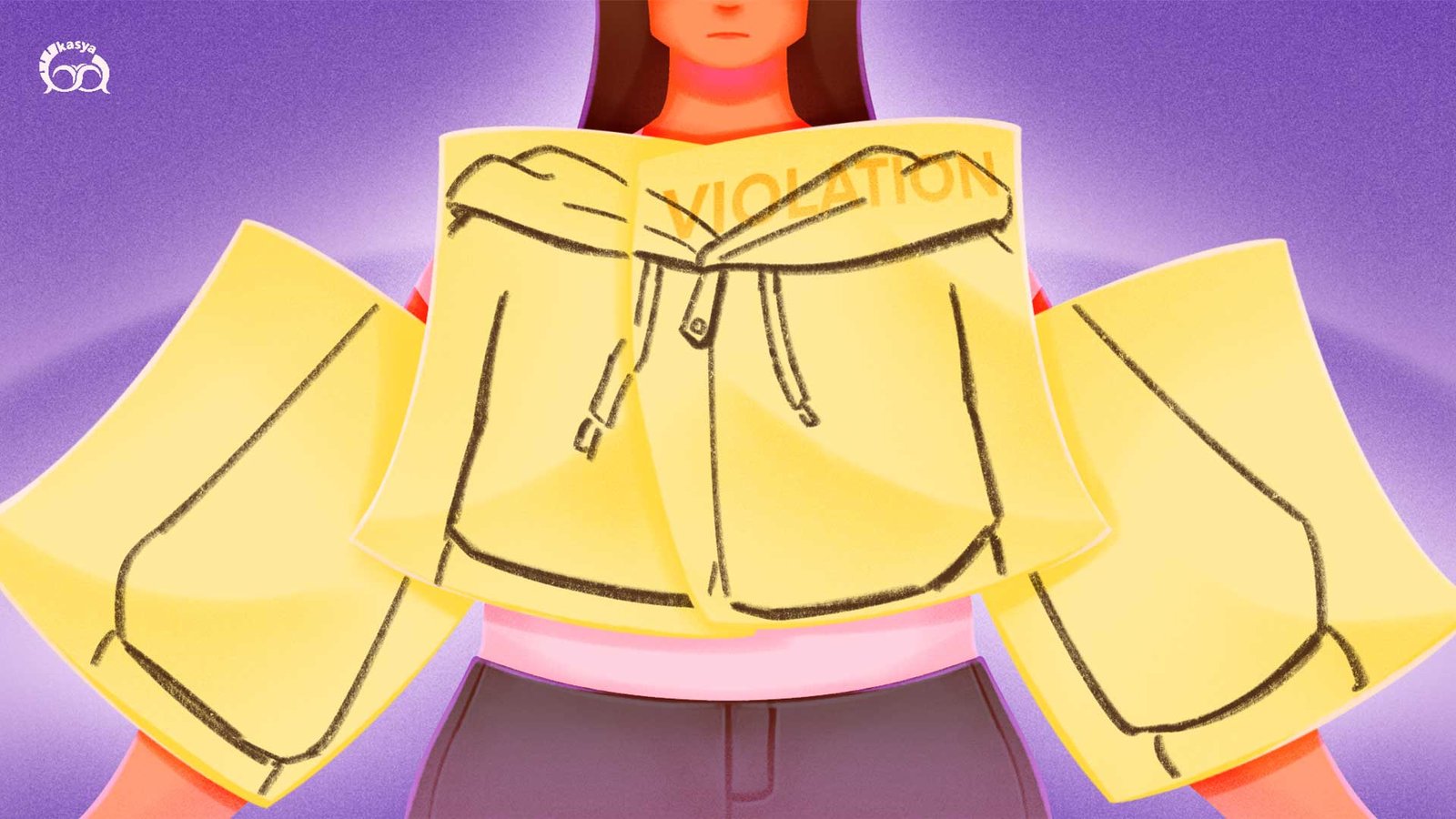
The morning sun was soft and golden when I stood before the mirror, adjusting my three-inch strap tank top and high-waisted jeans.
It was a simple outfit, one I’d seen countless girls wear on campus. I felt good, free even.
After years of wearing uniforms, college finally gave me the space to express myself through fashion.
But as I reached the university gate, a female guard stopped me. Her voice was polite yet firm, she said: “Miss, please cover up and fill out the dress code violation form.”
Confused, I slipped on the jacket I had in my bag and started filling out the online form. Then I noticed another student walk past, wearing the exact same outfit. No one stopped her.
That’s when it hit me, it wasn’t the outfit. It was me. It was my body, my chest that made the same clothes look “inappropriate.”
That moment opened my eyes to something deeper than a rule. It revealed how women’s bodies, especially curvier ones, are still judged and sexualized every day.
The Hidden Rules Beneath the Rules
Dress codes are often presented as neutral policies to promote modesty and professionalism. But in practice, they carry hidden biases that target certain bodies more than others.
Rules like “no low necklines,” “avoid tight clothing,” or “straps must be three inches wide” sound objective, yet their enforcement tells another story. A top that looks modest on one woman might appear “too fitted” on another, simply because of their body shape.
Our previous research on “All Sizes Matter: Accessibility, Affordability, and Representation of Plus-Size Bras for Women in the Philippine Market Through Consumer Perception and Retail Availability” addressed a few points.
Dress codes reflect social norms that equate decency with thinness and invisibility, placing more restrictions on women whose bodies naturally draw attention.
They are less about discipline and more about control, a quiet policing of what femininity should look like.
Online communities such as Reddit’s r/bigboobproblems echo this truth.
One comment said, “Because of my body shape, I keep getting dress-coded… I can’t help how my body looks, and I shouldn’t be punished for it.”
While another said, “I have big boobs, and even my plain blouses are called inappropriate.”
These voices reveal a consistent pattern: the body, not the clothing, is being judged.
The Quiet Toll of Being Dress-Coded
For women with fuller busts, getting dressed can feel like walking a tightrope between comfort and caution.
You begin every morning with silent questions like: Is this top safe? Will someone ask me to cover up?
It isn’t vanity; it’s defense.
As our research highlights, repeated policing of clothing fosters shame and self-surveillance, women start monitoring their own bodies before anyone else does.
Many end up hiding beneath oversized clothes or layers, even in the heat, just to avoid unwanted attention.
One woman shared, “I wear baggy sweaters every day, not because I want to, but because I’m tired of being sexualized.” Another said she stopped wearing V-necks entirely.
For plus-size women, the scrutiny doubles. The study notes that larger bodies face intersecting stigma, viewed as both undisciplined and overly visible.
The same outfit that looks “cute” on one person can be labeled “provocative” on another. It’s not about intention; it’s about perception.
Why It Hurts and Why It Happens
The unfairness goes far beyond a single rule or moment at the gate. It’s rooted in how society has long viewed women’s bodies as things to regulate.
For decades, media and advertising have sexualized the female chest, turning a natural body part into something to hide or manage.
When dress codes ban “cleavage” or “tight clothing,” they echo that old narrative: that women must protect others from discomfort.
As our research observes, girls learn early to adjust their behavior, while boys are rarely taught to adjust their gaze. This imbalance normalizes the idea that responsibility for “decency” lies with women alone.
There’s also a design flaw. Dress codes are written as if all bodies are the same, but they aren’t. A “three-inch strap” or “loose-fitting blouse” means something different on every figure.
Instead of updating the rules to reflect that diversity, institutions often adjust their judgment, unfortunately, unfairly.
In these moments, dress codes stop being about neatness or professionalism. They quietly shape how women learn to see their bodies, as something that needs to be hidden.
How We Can Do Better
Real change begins with rewriting the rules, both literally and culturally. Dress codes should focus on clothing, not anatomy.
Clear, inclusive guidelines such as “shoulders must be covered” or “shorts must reach mid-thigh” are more equitable than vague phrases like “no revealing outfits.”
Training administrators, teachers, and HR staff to recognize bias can prevent humiliating enforcement. And representation matters, showing diverse body types in dress code visuals tells students and employees that they all belong.
The research also recommends open channels for feedback, allowing individuals to report unfair treatment without stigma. Even small conversations can spark policy reform when patterns of bias are made visible.
Finally, solidarity changes everything.
When women share their experiences, may this be online, in classrooms, or within offices, they remind each other that these aren’t isolated incidents but part of a larger social issue that can be challenged.
Rewriting Respect
I still remember standing at that gate, jacket zipped, shoulders hunched, feeling small. Back then, I thought I had broken a rule. Now I know the rule was never written for me.
That day wasn’t about my top or my straps. It was about visibility, about how easily confidence is mistaken for indecency when it comes from a woman with curves.
Dress codes claim to teach respect, but real respect isn’t about covering up; it’s about acknowledging that everybody deserves dignity.
So maybe it’s time to stop asking women to shrink to fit the rules and start asking why the rules were never designed to fit us. Because our bodies are not distractions.
They are not violations. They are simply human.
And if fashion is self-expression, then the most powerful thing a woman can wear is confidence, the quiet, undeniable kind that says:
“I am not the problem. My body is not a distraction. I am simply me.”